A stick-figure story of how the XRP Ledger works
A Walk Through the Ledger
Three stick figures and a busy little bee explain how the XRP Ledger works, simply enough for beginners and curious kids, and carefully enough for the facts to stay true.
Buzz
Chapter 1

Hello, traveler.
Before we open the notebook, meet your guides, and the bear who asked them to give you a tour.
Sol
Hi! I'm Sol. I'll keep us on the path. We're going to walk through a shared notebook called the XRP Ledger.
Luna
I'm Luna. I ask a lot of questions. Is this like a regular school notebook?
Gaia
I'm Gaia. I notice the little things. Also, there's a bear in a fancy hat waving at us.
What this walk is
The XRP Ledger is a shared, public ledger. It keeps track of balances and the transactions that change them, without one person being in charge of the book.
This page is a fan-made story, created during #XRPEducationMonth 2026 and invited by the XRP Ledger Foundation (@XRPLF). We'll use plain words, then give you comics and games if you want to go deeper.
Every fact here is written to match xrpl.org. We won't talk about prices, trading tips, or where to buy anything.
That's Astro Bear, popping in for a cameo. The stick figures are your main guides. The bear just likes a good story, and a good riddle.
Chapter 2
A notebook everyone shares.
A ledger is just a careful record. The XRP Ledger is one the whole network can check together.
Luna
Okay, but what's a ledger, really?
Sol
Think of a notebook the whole class shares. Every finished page is a picture of everything in the notebook right now, plus the list of changes that made this page from the last one.
Gaia
Everyone keeps a copy. The copies have to match, or the page doesn't count.
Ledger versions
Each finished page is called a ledger version, or just a ledger. It holds three things: the current state (like balances), the transactions that were applied to the previous ledger to get here, and some metadata, including a number called the ledger index, and a fingerprint of the page's contents.
The shared rules are the great architect of this notebook. They shape every page, and no one person is in charge of the book.
Ledgers are numbered in a line, each one building on the one before it, all the way back to the start. When the network agrees a page is right, that ledger is validated. Then it is final. Nobody can quietly rewrite it later.
Unlike some blockchains, each new ledger carries the current state with it. You don't have to collect every old page just to know what's true right now.
Chapter 3
Buzz
Comic
Built to Agree
Want the longer story of agreement? Astro Bear made a riddle comic about validators who must see eye to eye.
Open the comic →
Comic · Español
Hecho para acordar
The same story, in Spanish, for friends who want to walk the ledger in another language.
Abrir el cómic →
How they all agree.
If nobody is the teacher, who says the page is finished? Validators do it by coming to consensus.
Luna
So who gets to write in the notebook?
Sol
Special computers called validators. Each one suggests what should go on the next page. Then they listen to the validators they trust, and they keep adjusting until almost all of them agree.
Gaia
That's called consensus. Agreeing is the whole trick.
Buzz
Don't mind the humming. I'm Buzz. A hive works because every bee does its part. Validators are like that: they keep at the work together, with no prize for finishing a page, until the whole hive agrees. Industry and cooperation: that's how a ledger gets written.
Consensus, in plain words
The XRP Ledger does not use mining, and nobody is paid a prize for finishing a page. Validators propose, compare, and revise until they share the same result.
On this ledger, everyone meets on the level and parts on the square: the same rules apply to every account and every validator. Nobody gets a private shortcut.
A little trust goes a long way: each server chooses a list of validators it expects to behave honestly most of the time, and that shouldn't all cheat in the same way. If too many of them are missing or misbehaving, the network waits instead of writing down something wrong.
The design puts correctness and agreement first, then forward progress. A paused notebook is safer than a messy one.
Try it: help them agree
Tap each validator so they raise a hand. When all five agree, the next ledger can close.
A validator watching the network.
0 of 5 validators have raised a hand. Tap the rest so they can agree.
Chapter 4
Game
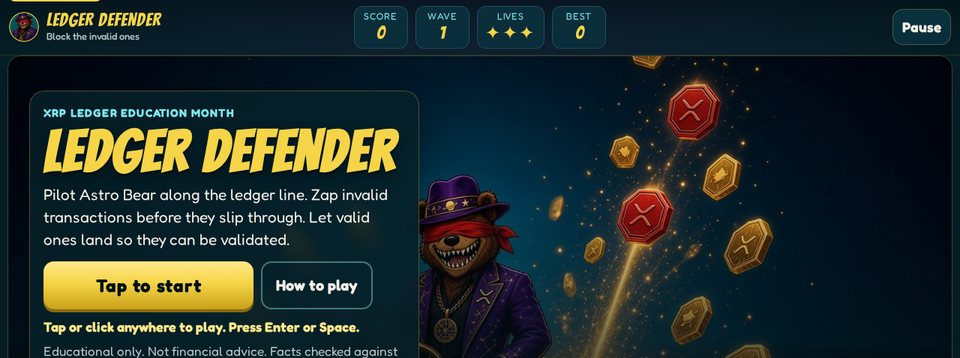
Ledger Defender
Practice keeping junk off the ledger in this free arcade-style education game. Slow enough to read the facts as you play.
Play Ledger Defender →
The fee that vanishes.
If sending a note is easy, what stops a prankster from filling the notebook with junk?
Luna
Couldn't someone just write "banana banana banana" a million times?
Sol
That's why every transaction must destroy a tiny bit of XRP. It isn't paid to anyone. It vanishes. That little cost makes spam expensive, and it can rise if the network is busy.
Gaia
The tiniest usual amount is 10 drops. A drop is one millionth of one XRP. Really, really small, unless someone tries to flood the page.
The transaction cost
Every signed transaction has to say how much XRP to destroy as its transaction cost. The XRP is irrevocably destroyed. It is not paid to validators or to any other party.
The network's minimum can increase when load is high, which makes it very expensive to overload the ledger on purpose, or by accident. That cost is a square deal: the same rule, checked the same way, for every transaction.
The ledger does exactly what the signed transaction says, including the fee. That's why the amount in the Fee field is the amount that disappears.
Try it: watch a fee vanish
Tap the spark. It stands in for a tiny XRP fee.
Chapter 5
Kids' comic
Built to Agree: Kids Edition
A gentler telling of the agreement story, with coloring pages you can color online or print.
Open the kids' edition →
Your locker on the ledger.
An account is a place that can hold XRP and other things. It needs a small reserved amount to exist.
Sol
An account is a bit like a locker. To open one, it has to hold a small reserved amount of XRP.
Gaia
On Mainnet today, the starting reserve is 1 XRP. Extra items in your locker usually add 0.2 XRP each. Your first two trust lines are a special case and don't add that extra.
Luna
So the reserved XRP is stuck in the locker forever?
Reserves, gently
You can't send the reserved XRP away to someone else, but it can be used to pay those tiny transaction costs. One way to look at it: the reserve pre-funds your locker so it can keep paying fees.
A level and a plumb are quiet reminders: every locker is measured by the same reserve rules, on the level, no matter who it belongs to.
If an account goes below its reserve, it still exists. It just can't send XRP to others, or add new items that would raise the reserve, until it holds enough again.
Reserve amounts can change over time when validators vote on fee settings. The numbers above are today's Mainnet values, as documented on xrpl.org.
LOCKER 589
Chapter 6
Game
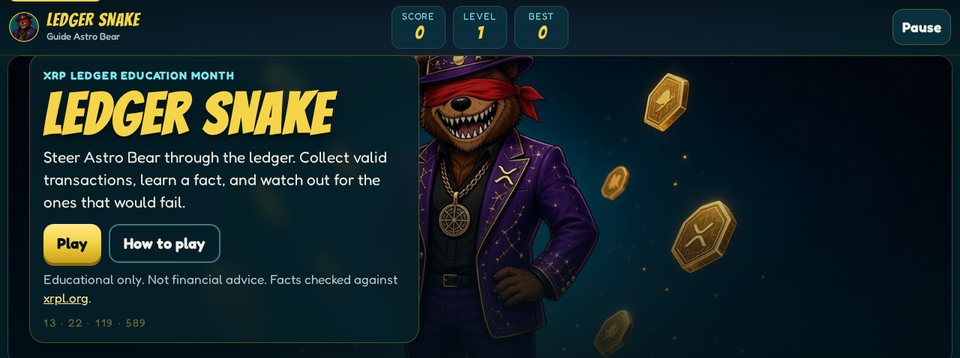
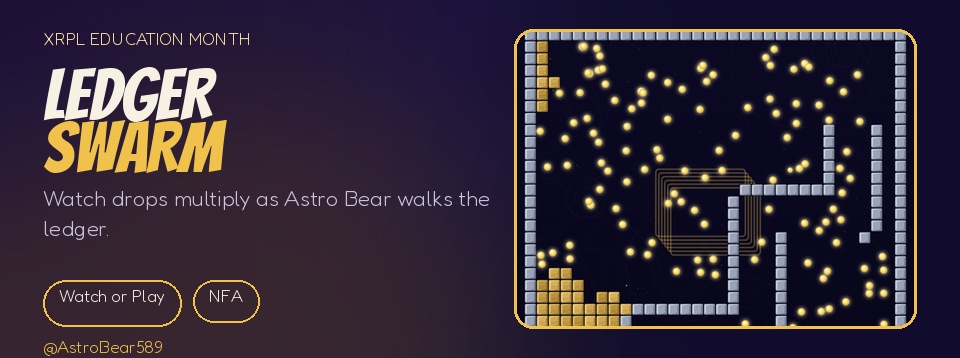
Ledger Snake
Follow the path in order and collect XRPL facts in this free education game.
Play Ledger Snake →
Ticket numbers in a line.
How do you stop the same payment from happening twice? You take a number, and you use it only once.
Luna
What if someone tried to use the same payment twice?
Sol
Every account has a sequence number, like the ticket you take at a bakery. Your next transaction must use the very next number: exactly one higher. You can't use the same ticket twice, and you can't skip ahead.
Gaia
That keeps payments in order. It also helps stop a double spend: spending the same money twice.
Sequences are picky, on purpose
A transaction from an account is only valid if its Sequence is exactly 1 greater than the last one that account sent. (There's a special tool called a Ticket for some advanced cases, but the everyday rule is "next number, please.")
Together with consensus putting transactions in a final order, sequence numbers help the ledger solve the double-spend problem without a central cashier.
The fee, the reserve, and the sequence number are the ledger's working tools. They keep the book in order.
A proposed transaction starts as a rough ashlar: a stone that isn't finished yet. When the network agrees and the ledger is validated, it becomes a perfect ashlar: measured, placed, and unchangeable.
A riddle from the bakery line
I go up by one, and never twice. Skip me and the line won't move. What am I?
A sequence number. Your next transaction has to take the very next ticket: no doubles, no skipping.
Chapter 7
Game
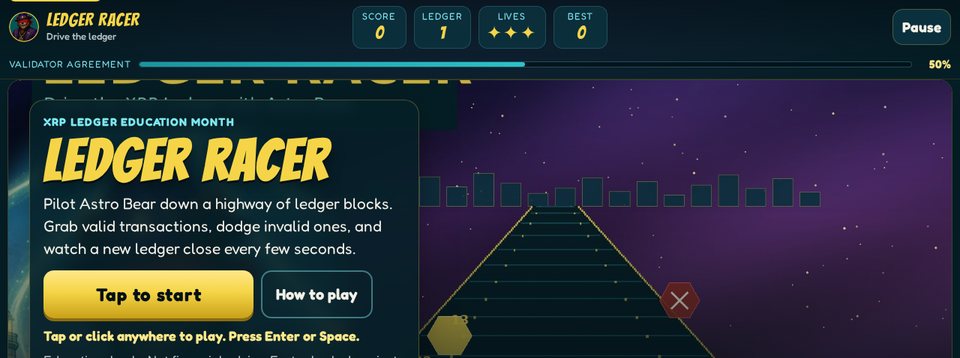
Ledger Racer
Race from ledger close to ledger close in this free driving education game, with facts along the road.
Play Ledger Racer →
A new page, every few seconds.
The notebook doesn't wait around. New ledger versions usually close about every 3 to 5 seconds.
Luna
That's faster than I can tie my shoes!
Sol
Once a ledger is validated, that page is final. Then everyone starts work on the next one. The pages keep coming, one after another.
Gaia
Official close times are rounded a little so validators can agree on the clock. The important part for us: a new page usually lands in a handful of seconds.
Buzz
Buzz
From labor to refreshment: that page is finished, and the work can rest. Then a new light comes from the East: the next ledger, a fresh picture of what's true right now.
Watch the pages turn
Previous ledger
Ledger 119Usually closes about every 3 to 5 seconds.
Why "a few seconds" matters
Because the whole network has to agree on each page, the XRP Ledger is built for steady, shared progress, not for rushing faster than consensus can be careful.
When a ledger is validated, its contents can never change. The validated ledgers before it are history. The network is already considering transactions for the next one.
Chapter 8
Mini-comic
Sealed Envelopes
A short comic about Confidential Transfers, a proposed feature, in a validator vote, that would let certain issued tokens hide amounts while still allowing approved checkers to look when they need to.
Open the mini-comic →
Tokens and trust lines.
XRP lives in the ledger itself. Other tokens work a little differently: they sit on trust lines.
Sol
A trust line is an agreement between you and the issuer of a token, with a limit on how much of it you're willing to hold.
Luna
So I only hold a token if I choose to trust the issuer?
Gaia
That's the idea. A token is identified by both its name and its issuer. Two tokens with the same name but different issuers are not the same thing.
Issued tokens, carefully
Anyone can issue a token with a currency code they choose. That's why the issuer matters, and why the ledger tracks tokens on trust lines instead of mixing them all together.
A trust line is a bit like a cable tow: you choose how far you're willing to go with an issuer, by setting a limit on how much of that token you're willing to hold.
XRP itself does not use a trust line. It is the ledger's native asset, and it can be sent directly from account to account.
This walk won't send you toward any particular token or issuer. We're only explaining how the tool works.
Chapter 9
A marketplace built into the notebook.
The XRP Ledger has a decentralized exchange in the protocol itself, not a shop we're sending you to.
Sol
People can post offers, like notes on a bulletin board, to exchange one kind of token for another, or for XRP. The ledger matches those offers when it closes a new page.
Gaia
There's no company in the middle collecting a cut. Like any other transaction, a tiny amount of XRP is destroyed as the fee.
Luna
So it's a tool in the notebook, not a storefront?
The built-in DEX, at a high level
Yes. An offer is a limit order recorded on the ledger. If a matching offer already exists at a good enough rate, it can be filled right away. If not, the leftover offer can sit in the ledger until a later page matches it, or until it's canceled. Offers match on the level: the same matching rules, for everyone.
Because offers only settle when a ledger closes (about every 3 to 5 seconds), the design is meant for careful matching, not for racing the clock.
We're showing you that this tool exists in the protocol. We are not asking you to use it, and we won't point you to any particular token, project, or venue.
Chapter 10
Did it stick?
Three quick questions. No grades, no pressure: just a chance to see what you caught.
1. What happens to the tiny XRP fee on a transaction?
2. How does the XRP Ledger decide the next page of the notebook?
3. About how often does a new ledger usually close?
Chapter 11
The arcade is open.
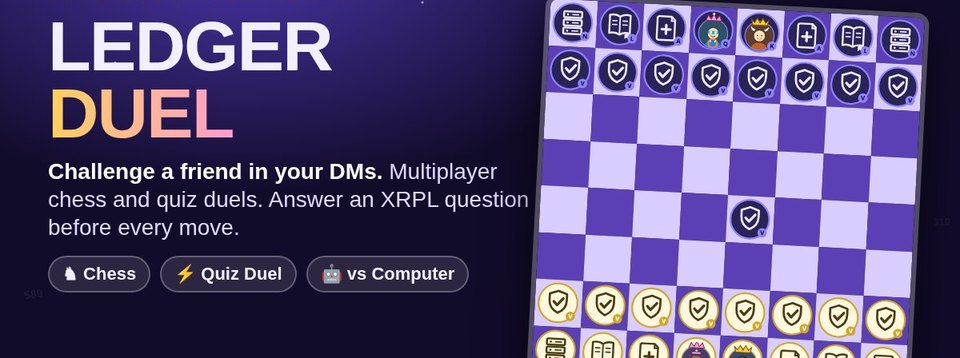
Free XRPL games for kids and beginners, ready to play in your browser. No accounts. Just facts, and a little fun. All of the games, including the $LHT arcade and titles on the way, live at arcade.astrobear589.com.
Sol
If you want to practice what we just walked through, the arcade is open. Pick a game, and the facts come with you.
Buzz
Buzz
I'll keep the path lit. Comics, the kids' edition, and the video hub are still down in Explore, if you want those next.
Loading the arcade...
Chapter 12
Validated.
A short video series that explains how the XRP Ledger works, one lesson at a time. Stick-figure transactions fight to get validated. Astro Bear is the mentor, and the final boss.
Luna
If you'd rather watch than play, the transactions themselves put on a show.
Gaia
Episode 1 is The Signature Check: a signature has to check out, and a 10 drop fee is burned. Hit play when you're ready.
Loading the series...
11 November 2026
Episode 1: The Signature Check
A signature must check out, and a 10 drop fee is burned.
12 November 2026
Episode 2: Finish It
A malformed transaction is stamped temINVALID, never enters a ledger, and pays no fee.
Chapter 13
Explore everything.
Comics, coloring pages, and a video hub, all free. They were created during XRPL Education Month 2026. Games live in the Arcade, and Validated has its own stage. The full comics shelf is at comic.astrobear589.com.
Hub
Astro Bear Arcade
All of the live games in one place, plus a look at what is coming soon.
Open the arcade
Hub
Astro Bear Comics
Education comics, the kids edition, and the community riddle comics, all with their covers.
Open the comics
Start here
New to blockchains?
A short beginner guide: what a blockchain is, why a shared ledger matters, and how the XRPL reaches agreement.
Read the guide
Comic
Built to Agree
Astro Bear's riddle comic about validators who must agree.
Open →
Mini-comic
Sealed Envelopes
Confidential Transfers, explained as sealed envelopes. A proposed feature in a validator vote.
Open →
Comic · Español
Hecho para acordar
The Built to Agree story, in Spanish.
Abrir →
Kids' edition
Coloring pages
A gentler edition of Built to Agree, with pages you can color online or print.
Color online →
Hub
Video & riddle cards
A short video about a proposed Lending Protocol (in a validator vote, not live yet) plus shareable riddle cards.
Open the hub →